Using CDISC-ODM in EDC
Electronic Data Capture and the CDISC ODM Standard
|
The use of open standards can considerably reduce the costs of electronic data capture (EDC) in clinical research.
The CDISC ODM standard for example allows to automatically set up the EDC system, to create and instantiate the database, and to fully automate
the creation of electronic case report forms (eCRFs).
The reason for this is that the Study section of a CDISC ODM file can capture all the necessary information about the visits, forms, questions, codelists etc..
to set up the EDC system and the eCRFs fully automatically.
With classic EDC systems, the system has to be set up "by hand" for each new study that is started,
and the eCRFs need to be designed and created using information from the sponsor which is, at best, delivered in the form of Word or PDF documents.
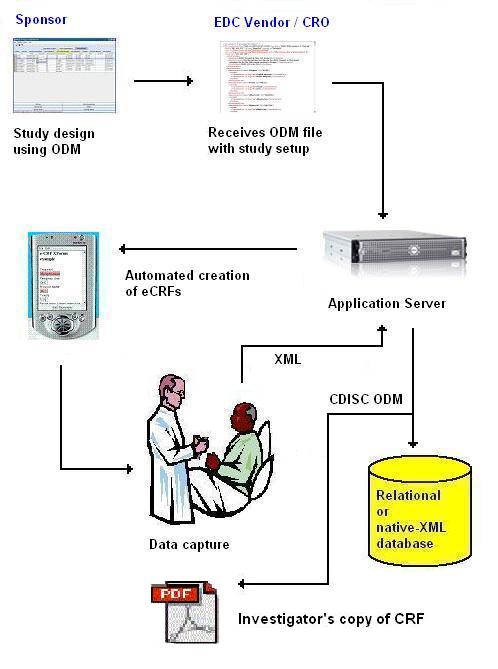
Sponsors can however now design the whole study design using a user-friendly design tool that exports its results in CDISC ODM format.
This ODM file can be send to the EDC vendor, allowing the latter to set up the whole EDC system including the creation of eCRFs in a matter of minutes.
The newest version of the CDISC ODM Standard (version 1.3) has a number of new features and enhancements directed to its use in EDC:
- Internationalization at all levels of the study setup: this allows e.g. to automatically create eCRFs for any of the required languages
- New datatypes, including boolean, durations, partial date and datetime etc..
- Conditions and conditional processing: the design can state the conditions under which a visit must not be performed, a form must not be used,
a question must not be asked, and all this as well in machine-readable language (most useful in eCRFs) as in human-readable language (most useful in paper forms).
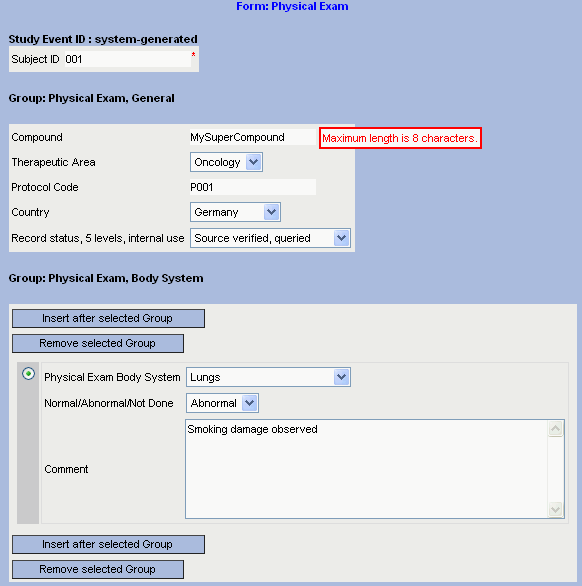
Some samples ...
| |
Read our article in Applied Clinical Trials "CDISC Standards energize EDC" about the use of the CDISC ODM 1.3 standard in electronic data capture.
Our Services
As one of the main contributors to the development of the CDISC ODM 1.3 standard (especially the EDC-related new features),
and our long-time involvement (5 years) in the development of the CDISC ODM standard,
XML4Pharma offers implementation services to EDC vendors, CROs and pharma companies:
- Consultancy for and implementation of ODM in EDC systems: we already performed a number of projects for EDC vendors where we helped them
adapting their EDC system for use with the CDISC ODM standard:
- For an EDC vendor, software was developed to export the study setup in ODM format, and to import clinical data in ODM format into their Oracle-based system.
The results have been presented at the European CDISC Interchange 2006 in Berlin. A copy of the slides can be found here.
Technologies that were used: PL/SQL, Oracle XML-SQL, XSLT2, Java
- For a young, rapidly expanding EDC vendor in North America, software was developed to automatically set up the clinical database and EDC system automatically
from CDISC ODM files with metadata (including AdminData), and to import clinical data in ODM format into the existing EDC database. This allowed the vendor to
specialize in rescue studies, i.e. clinical studies that otherwise need to be stopped as the technology provider went out of business.
With these new capabilities of their EDC system, they can also attract new customers that want to start using EDC, even in the mid of a running study.
Technologies used: C#, in combination with a SQLServer database.
- Development of ODM Vendor Extensions
- Special features of EDC that are not covered by the core ODM, can easily be incorporated in the ODM XML-schema by using a "Vendor Extension" XML-Schema.
The great advantage is that all the advantages of using the ODM are maintained, and that the instance ODM documents with data for these features can
easily be validated against the schema (and the ODM standard) without the need for special software.
- Another advantage is that with such a vendor extension XML-Schema, data can be send to the regulatory authorities in ODM format
although they contain data for the extra features: the ODM Extension XML-Schema is just send together with the ODM files to the authorities.
Remark that regulatory authorities more and more ask for additional data for individual subjects, which they prefer to come in CDISC ODM format.
- Consultancy for and software development for automated transformation of ODM study setups into eCRFs.
We already developed this technology for use with XForms, and with our perfect knowledge of the ODM standard (as one of the core developers of this standard),
and our excellent knowledge of programming languages for use with XML (such as Java, C# .Net, etc..), XML4Pharma can be your first choice for other possible implementations,
for example Adobe interactive PDFs
Technology offerings
XML4Pharma has itself developed a new, fascinating technology for use in EDC. As we do not want to become an EDC Vendor ourselves, this technology is offered
to EDC Vendors, CROs and pharma companies.
The technology is based on the automated transformation of a study setup in CDISC ODM format (v.1.2 or 1.3) into a set of eCRFs based on XForms technology.
More about our technology
Life sample eCRFs
XForms, an open standard itself, is the successor of web forms (HTML forms).
Unlike web forms, XForms can be deployed on as well browsers, PDAs, smartphones, tablet PCs, etc., essentially on any web-based platform.
There are however also many other advantages compared to HTML forms.
Many XForms implementations are already available as plugins for browsers (e.g. from IBM, FormsPlayer, Mozilla),
others as native XForms/HTML browsers, as PDA browsers (e.g. DataMovil), or as server side implementations, e.g. using Ajax technology.
Our application server based technolgy accepts a CDISC ODM file and transforms it into a set of interactive eCRFs in XForms format (one for each Form definition in the CDISC ODM file).
The eCRFs in XForms can then be deployed in an EDC system.
In our demo application, eCRFs are created on-the-fly from a CDISC ODM file, and can then be filled by the user.
Upon submit, they are converted into CDISC ODM clinical data.
For demo purposes, the obtained ODM is shown to the user. At the same time however, the ODM is also transformed into a PDF document (also shown to the user).
In a real system, the latter can be implemented so that the PDF is stored in the investigators document management system, or is automatically printed
on the investigators personal printer, or is simply shown to the investigator on the screen of his electronic device.
More about about automated creation of eCRFs directly from CDISC ODM files
View and try out some of the automatically generated eCRFs

XML4Pharma, Schlossbergstr. 20, 78224 Singen, Germany. Phone: +49 7731 975044